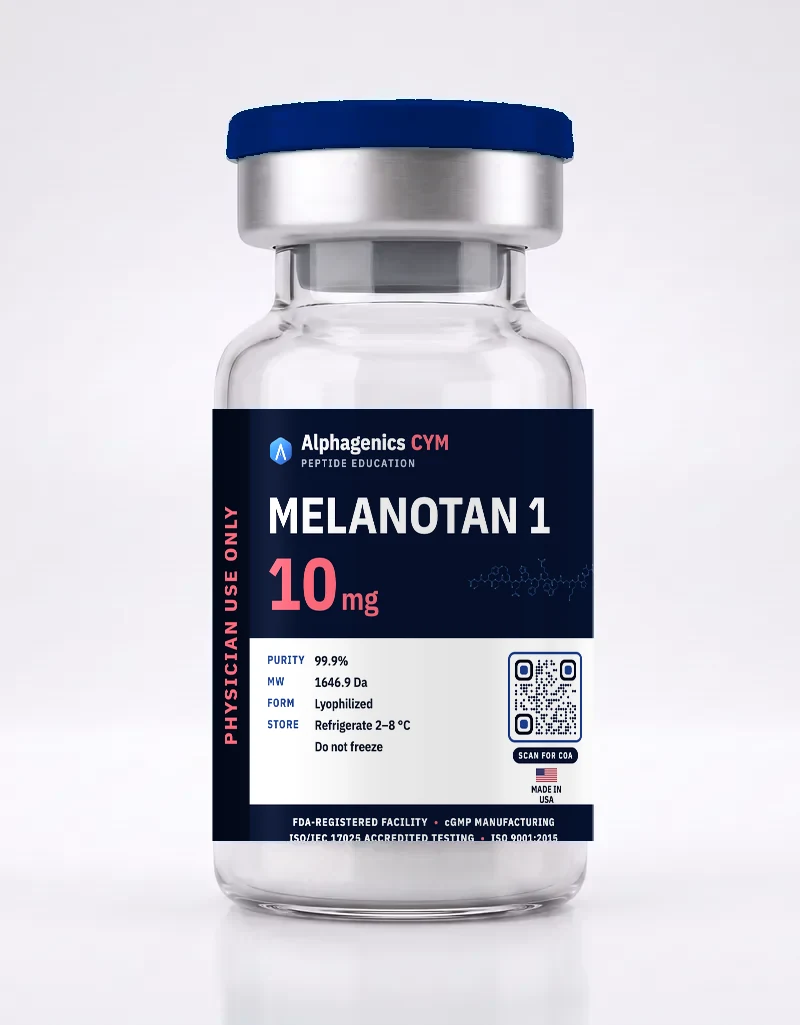
Melanotan 1
Afamelanotide · Melanotan I · [Nle4, D-Phe7]-α-MSH · NDP-MSH · CUV1647
Linear α-MSH analog, melanocortin 1 receptor (MC1R) agonist
About Melanotan 1
Melanotan 1 is the name by which afamelanotide ([Nle4, D-Phe7]-α-MSH) is known: a linear 13-amino-acid analog of alpha-melanocyte-stimulating hormone (α-MSH), synthesized in 1980, with greater activity and stability than the natural hormone.
It binds to the melanocortin 1 receptor (MC1R) on melanocytes, whose activation increases melanin synthesis and darkens the skin without the need for sun exposure. Unlike melanotan II, it has completed phase 3 clinical trials: as a controlled-release subcutaneous implant (Scenesse), it was approved by the EMA in 2014 and by the FDA in 2019 for phototoxicity in adults with erythropoietic protoporphyria. The clinical data come from that formulation.
Structure and sequence
Sequence

Five findings from studies
Summary of results reported in the scientific literature. Each finding describes what was observed in the cited study, in its specific population and conditions; it does not constitute a therapeutic indication.
-
Clinical study
In two multicenter, randomized, double-blind, placebo-controlled phase 3 trials in patients with erythropoietic protoporphyria (94 in the United States and 74 in the European Union), the afamelanotide implant has been associated with more hours of direct sun exposure without pain: median 69.4 versus 40.8 hours with placebo in the U.S. study (6 months; P = 0.04) and 6.0 versus 0.8 hours in the European study (9 months; P = 0.005), with fewer phototoxic reactions in the latter (77 versus 146) and better quality of life in both; adverse events were mostly mild.
Langendonk JG et al. N Engl J Med. 2015;373:48-59 · PMID 26132941 -
Clinical study
In a randomized multicenter trial in adults with nonsegmental vitiligo, afamelanotide plus narrowband UV-B phototherapy (n = 28) has been associated with faster and greater repigmentation than phototherapy alone (n = 27): 48.64% versus 33.26% at day 168; the improvement was more evident in skin phototypes IV to VI, with no significant difference in phototype III. Erythema was observed in both groups, and minor infections and nausea in the combination group.
Lim HW et al. JAMA Dermatol. 2015;151:42-50 · PMID 25230094 -
Review
A review of its pharmacology describes full bioavailability by the subcutaneous route, whereas oral or transdermal administration produced no measurable plasma concentrations or pigmentation response; it also notes that the EMA approved it in 2014 for the prevention of phototoxicity in adults with erythropoietic protoporphyria and that no late effects were reported in volunteers 25 years after first exposure.
Minder EI et al. Clin Pharmacokinet. 2017;56:815-823 · PMID 28063031 -
Regulatory
In 2019, the FDA approved afamelanotide (Scenesse), as a subcutaneous implant, to increase pain-free light exposure in adults with a history of phototoxic reactions from erythropoietic protoporphyria.
FDA. Scenesse (afamelanotide) — prescribing information, NDA 210797 -
Review
A review of published cases has described, with unregulated use of melanotan I and II, changes in existing moles, new (dysplastic) nevi and four cases of melanoma; a causal link has not been shown. The same review notes that afamelanotide is the only approved α-MSH analog, for a limited number of medical indications.
Habbema L et al. Int J Dermatol. 2017;56:975-980 · PMID 28266027
Frequently asked questions
What is Melanotan 1?
Melanotan 1 is the name by which afamelanotide ([Nle4, D-Phe7]-α-MSH) is known: a linear 13-amino-acid analog of alpha-melanocyte-stimulating hormone (α-MSH), synthesized in 1980, with greater activity and stability than the natural hormone. It binds to the melanocortin 1 receptor (MC1R) on melanocytes, whose activation increases melanin synthesis and darkens the skin without the need for sun exposure.
What target or receptor does Melanotan 1 act on?
Melanocortin 1 receptor (MC1R), agonist
What is the half-life of Melanotan 1?
≈15 h (apparent, with the controlled-release subcutaneous implant; FDA label)
What have published studies observed about Melanotan 1?
In two multicenter, randomized, double-blind, placebo-controlled phase 3 trials in patients with erythropoietic protoporphyria (94 in the United States and 74 in the European Union), the afamelanotide implant has been associated with more hours of direct sun exposure without pain: median 69.4 versus 40.8 hours with placebo in the U.S. study (6 months; P = 0.04) and 6.0 versus 0.8 hours in the European study (9 months; P = 0.005), with fewer phototoxic reactions in the latter (77 versus 146) and better quality of life in both; adverse events were mostly mild. (Langendonk JG et al. N Engl J Med. 2015;373:48-59, PMID 26132941) In a randomized multicenter trial in adults with nonsegmental vitiligo, afamelanotide plus narrowband UV-B phototherapy (n = 28) has been associated with faster and greater repigmentation than phototherapy alone (n = 27): 48.64% versus 33.26% at day 168; the improvement was more evident in skin phototypes IV to VI, with no significant difference in phototype III. Erythema was observed in both groups, and minor infections and nausea in the combination group. (Lim HW et al. JAMA Dermatol. 2015;151:42-50, PMID 25230094)
How is Melanotan 1 stored?
Refrigerate at 2–8 °C, do not freeze. Protect from light and moisture, unopened and once reconstituted.
What sizes is Melanotan 1 available in?
10mg


