LL-37
Human cathelicidin · hCAP18 (C-terminal fragment) · CAMP · Ropocamptide
Human antimicrobial peptide of the cathelicidin family
About LL-37
LL-37 is the only cathelicidin-family peptide found in humans.
It is the 37-amino-acid C-terminal fragment of the protein hCAP18, which is produced constitutively in leukocytes and induced in the skin and other barrier organs in response to injury or infection. Beyond its broad-spectrum antimicrobial activity, it has been studied for its role in wound re-epithelialization, in blood vessel formation and in the regulation of inflammation, including its involvement in inflammatory skin diseases such as psoriasis. As a topical drug (ropocamptide) it was evaluated in venous leg ulcers: a first small trial showed favorable results, but the later phase IIb trial did not meet its primary endpoint. It has no regulatory approval.
Structure and sequence
Sequence
Large molecule (4493.3 g/mol): the full structure is shown above; the sequence summarizes its amino-acid order. 3D model available on PubChem.

Five findings from studies
Summary of results reported in the scientific literature. Each finding describes what was observed in the cited study, in its specific population and conditions; it does not constitute a therapeutic indication.
-
In vitro
In human skin, hCAP18 rises after wounding and has been detected in the epithelium migrating over the wound bed, whereas it is absent at the edge of chronic ulcers; in an ex vivo human skin model, blocking LL-37 with antibodies inhibited re-epithelialization in a concentration-dependent manner.
Heilborn JD et al. J Invest Dermatol. 2003;120:379-389 · PMID 12603850 -
Preclinical
In the chorioallantoic membrane assay and in a rabbit model of hind-limb ischemia, LL-37 has been associated with new blood vessel formation, mediated by the FPRL1 receptor on endothelial cells; mice lacking CRAMP (the murine homolog) showed reduced vascularization during wound repair.
Koczulla R et al. J Clin Invest. 2003;111:1665-1672 · PMID 12782669 -
Clinical study
In a first-in-human randomized, double-blind, placebo-controlled trial in 34 patients with hard-to-heal venous leg ulcers (4 weeks of topical treatment), the 0.5 mg/mL concentration has been associated with a healing rate constant about 6 times higher than placebo; with 1.6 mg/mL it was about 3 times higher, without statistical significance, and with 3.2 mg/mL there was no difference versus placebo. No safety concerns were observed.
Grönberg A et al. Wound Repair Regen. 2014;22:613-621 · PMID 25041740 -
Clinical study
In the HEAL LL-37 phase IIb trial (148 patients with hard-to-heal venous leg ulcers, alongside compression therapy), topical LL-37 showed no significant improvement in healing versus placebo in the full population; a post hoc analysis observed improvements in the subgroup with ulcers of at least 10 cm². It was well tolerated.
Mahlapuu M et al. Wound Repair Regen. 2021;29:938-950 · PMID 34687253 -
In vitro
In studies with human cells, LL-37 has been observed to bind released self-DNA and turn it into a potent trigger of interferon production by plasmacytoid dendritic cells, through TLR9; the authors propose that this pathway may drive autoimmunity in psoriasis.
Lande R et al. Nature. 2007;449:564-569 · PMID 17873860
Frequently asked questions
What is LL-37?
LL-37 is the only cathelicidin-family peptide found in humans. It is the 37-amino-acid C-terminal fragment of the protein hCAP18, which is produced constitutively in leukocytes and induced in the skin and other barrier organs in response to injury or infection.
What target or receptor does LL-37 act on?
Microbial membranes; FPRL1 receptor on endothelial cells; complexes with self-DNA that activate TLR9 in plasmacytoid dendritic cells
What is the half-life of LL-37?
Not established in humans
What have published studies observed about LL-37?
In human skin, hCAP18 rises after wounding and has been detected in the epithelium migrating over the wound bed, whereas it is absent at the edge of chronic ulcers; in an ex vivo human skin model, blocking LL-37 with antibodies inhibited re-epithelialization in a concentration-dependent manner. (Heilborn JD et al. J Invest Dermatol. 2003;120:379-389, PMID 12603850) In the chorioallantoic membrane assay and in a rabbit model of hind-limb ischemia, LL-37 has been associated with new blood vessel formation, mediated by the FPRL1 receptor on endothelial cells; mice lacking CRAMP (the murine homolog) showed reduced vascularization during wound repair. (Koczulla R et al. J Clin Invest. 2003;111:1665-1672, PMID 12782669)
How is LL-37 stored?
Refrigerate at 2–8 °C, do not freeze. Protect from light and moisture, unopened and once reconstituted.
What sizes is LL-37 available in?
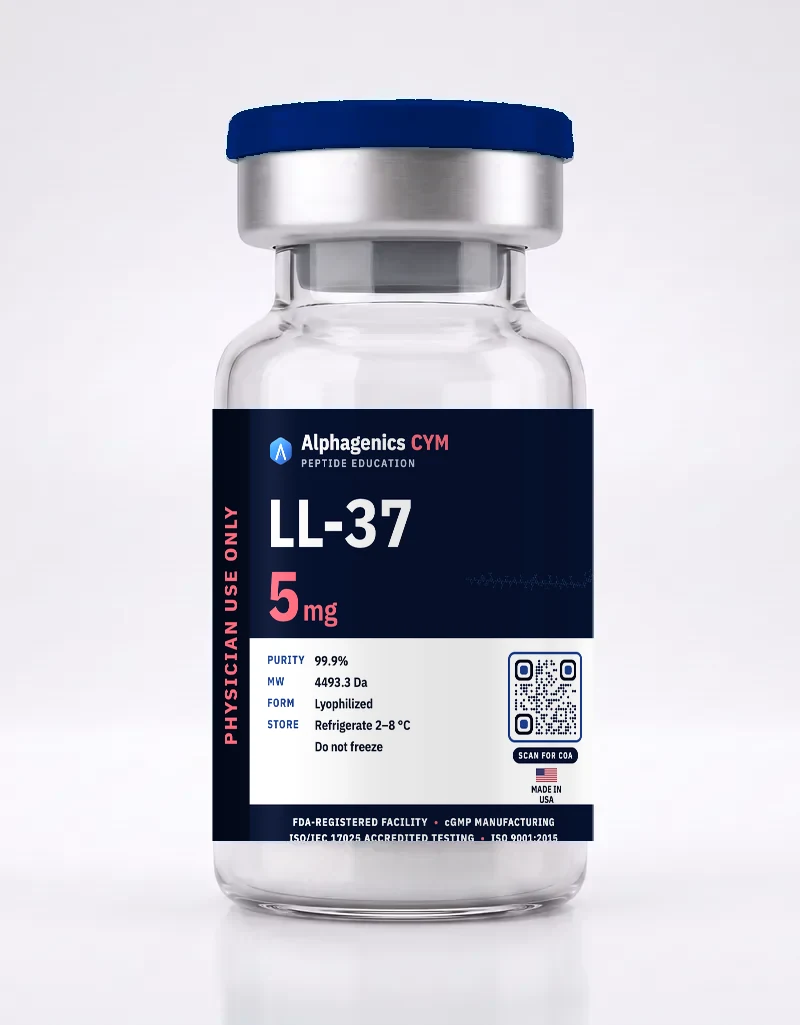
5mg